

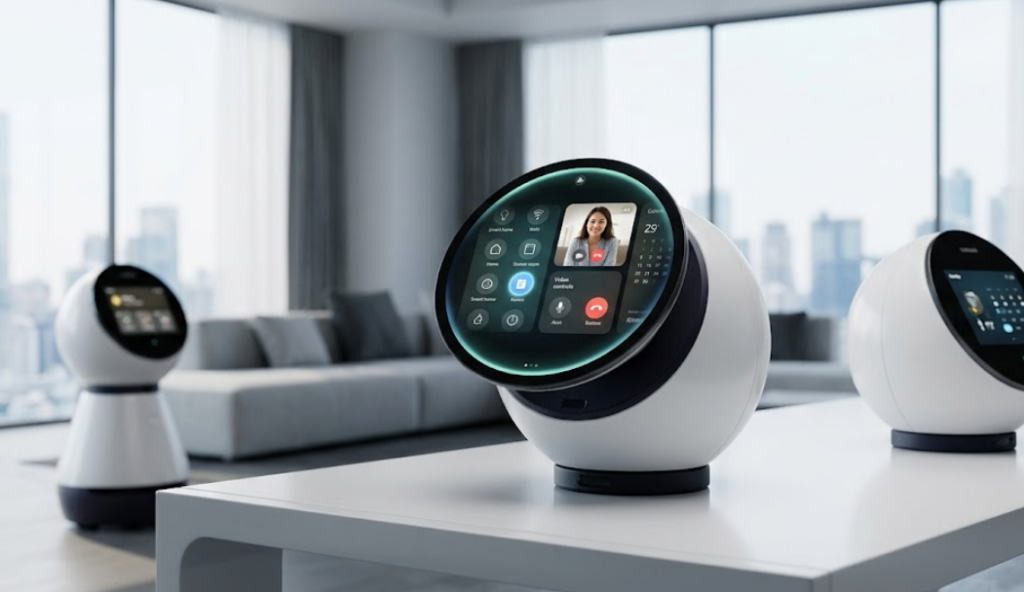
Samsung is pushing the boundaries of design and artificial intelligence with its latest concept, Project Luna. Unveiled as part of its experimental design efforts, this futuristic robot blends minimalism with advanced interaction concepts. While still in the prototype stage, Luna offers a fascinating look at how AI-powered companions could evolve in the near future.
Unlike traditional robots that focus on utility, Project Luna is clearly designed with personality and human interaction in mind.
A Unique Circular Display That Moves With You
The standout feature of Project Luna is its circular screen mounted on a swiveling head. This display can rotate and pivot, allowing the robot to “look” at users and follow their movements—creating a more natural, almost lifelike interaction.
The design has drawn comparisons to a turntable-style display, with the screen acting as both a face and an interface. This approach transforms the robot from a static device into something more expressive and engaging.
By combining motion with a simple circular display, Samsung is exploring how subtle physical cues—like turning toward a user—can make technology feel more intuitive and human.
More Than a Gadget: A Companion Concept
Project Luna isn’t just about hardware—it’s about redefining how people interact with machines. The robot is envisioned as an AI-powered assistant capable of communication, information display, and possibly smart home control.
Although Samsung hasn’t revealed full technical details, the concept suggests a future where devices act more like companions than tools. The rotating “head” could help the robot maintain eye contact, respond to voice commands, and deliver contextual information in a more engaging way.
This aligns with broader industry trends, where companies are focusing on making AI feel more personal and less mechanical.
Inspired by Samsung’s Design Philosophy
Samsung’s design team has emphasized that Project Luna is still a concept—but one that could become reality sooner than expected.
The company has a history of experimenting with bold ideas, from foldable displays to AI-driven ecosystems. Project Luna continues that tradition by combining form, motion, and intelligence into a single device.
The circular display also reflects a shift away from rectangular screens, suggesting that future interfaces might be more fluid and adaptable depending on context and use.
Challenges and Real-World Potential
Despite its appeal, Project Luna faces several challenges before it can become a real product. Questions remain about functionality, cost, and practical use cases. Will it be a home assistant, a productivity tool, or something entirely new?
There’s also the challenge of balancing innovation with usefulness. While the design is eye-catching, it will need meaningful features to justify its place in everyday life.
Still, concepts like Luna often serve as stepping stones—ideas that influence future products even if they never reach the market in their original form.
Final Thoughts
Samsung’s Project Luna is less about what exists today and more about what’s possible tomorrow. With its circular swiveling screen and focus on human-like interaction, it represents a bold step toward more personal, engaging technology.
While it remains a concept for now, Luna highlights a clear direction: the future of devices may not just be smarter—they may also feel more alive.
Read Also: Digital Clutter Is Weighing You Down
News Source: PCmag.com
Leave a Reply